

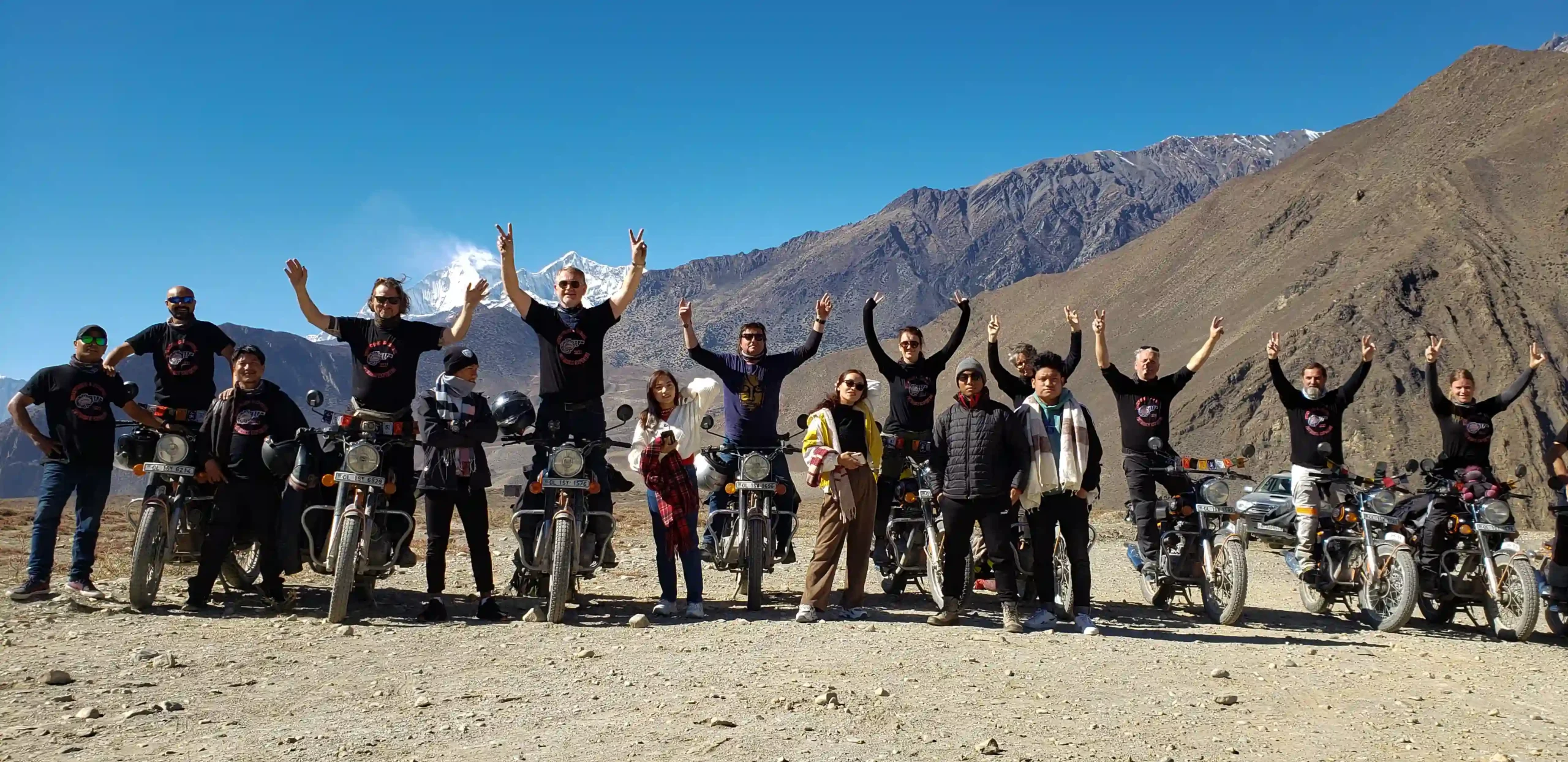
The Upper Mustang Motorbike Tour rides into one of the last places in Nepal that still feels like its own kingdom. Thirteen days take you from Kathmandu through the Kali Gandaki gorge, past Muktinath's eternal flame, through the checkpoint at Kagbeni, and into the walled city of Lo Manthang, once the capital of an independent Buddhist kingdom that stayed closed to outsiders until 1992. Firante's guides know this road well, the permits, the checkpoints, and exactly where the terrain turns from green valley to high desert.


Trip overview
The Upper Mustang Motorbike Tour is a 13-day ride from Kathmandu into the Kingdom of Lo, a former independent Buddhist kingdom that remained closed to the outside world until 1992. The route runs through the Kali Gandaki gorge, past Muktinath, through the restricted-area checkpoint at Kagbeni, and on to Lo Manthang, the walled former royal capital, before retracing the same road back out and returning to Kathmandu via Pokhara and Bandipur.
The Road In: Kathmandu to Kagbeni
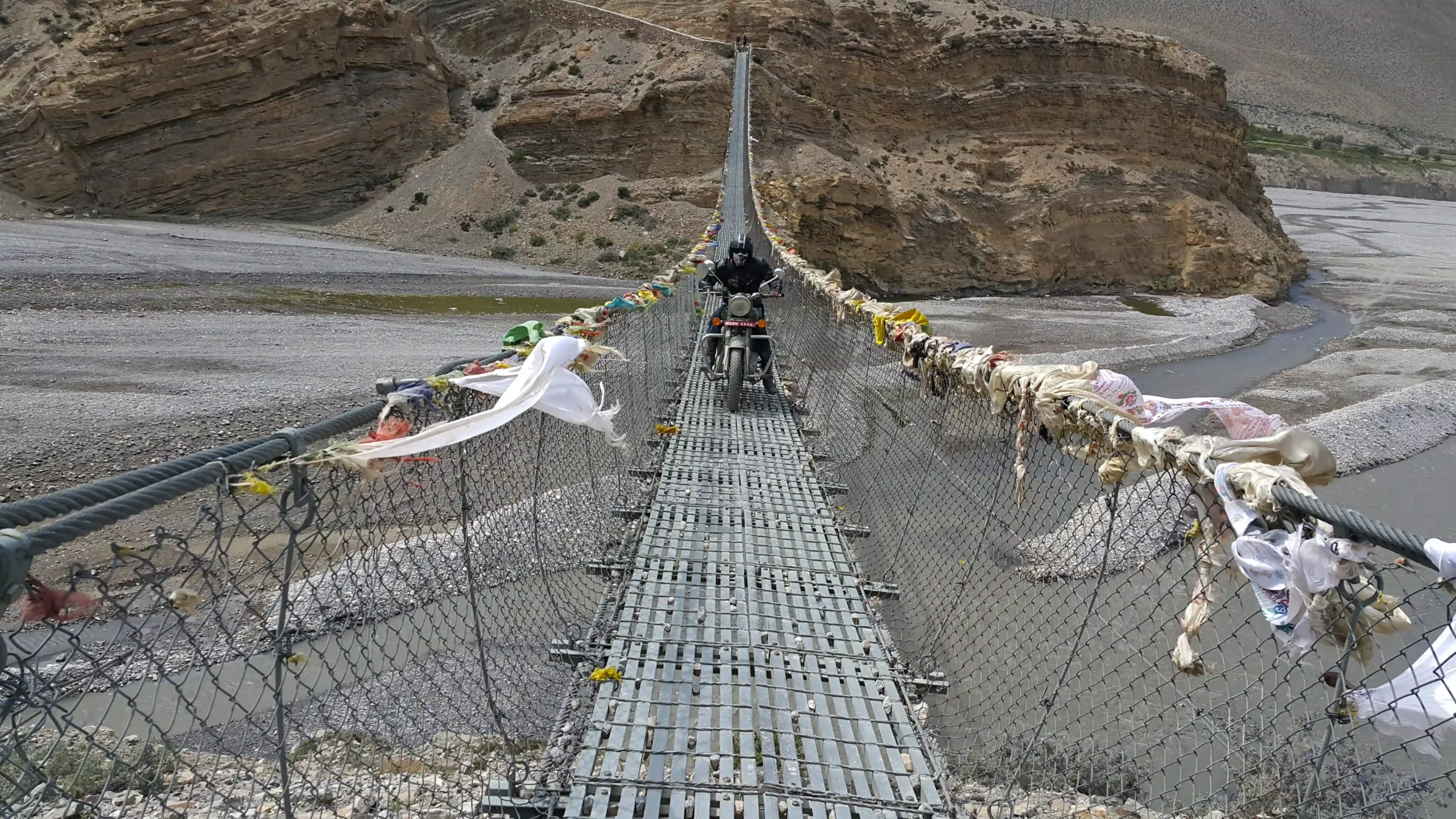
The first four days cover the approach: Kathmandu to Pokhara, Pokhara to Kalopani through the Beni-Tatopani corridor, and on through Ghasa, Lete and Marpha to Muktinath and Kagbeni. The road is paved most of the way to Kagbeni, and this stretch alone takes in Nepal’s longest suspension bridge at Kusma, the apple orchards around Ghasa, and Marpha’s whitewashed Thakali architecture, before the terrain and the rules both change at Kagbeni, the checkpoint where the restricted area begins.
Into the Restricted Zone: Kagbeni to Lo Manthang
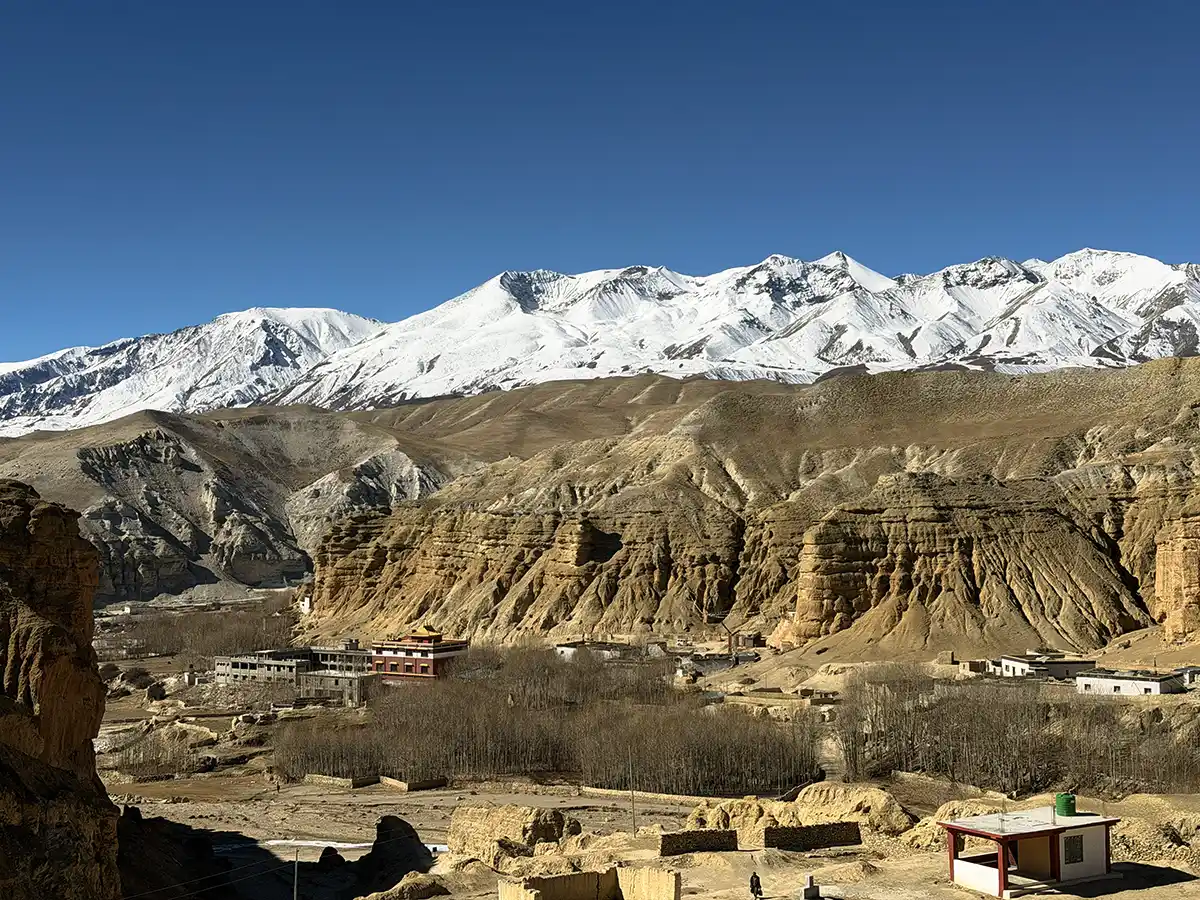
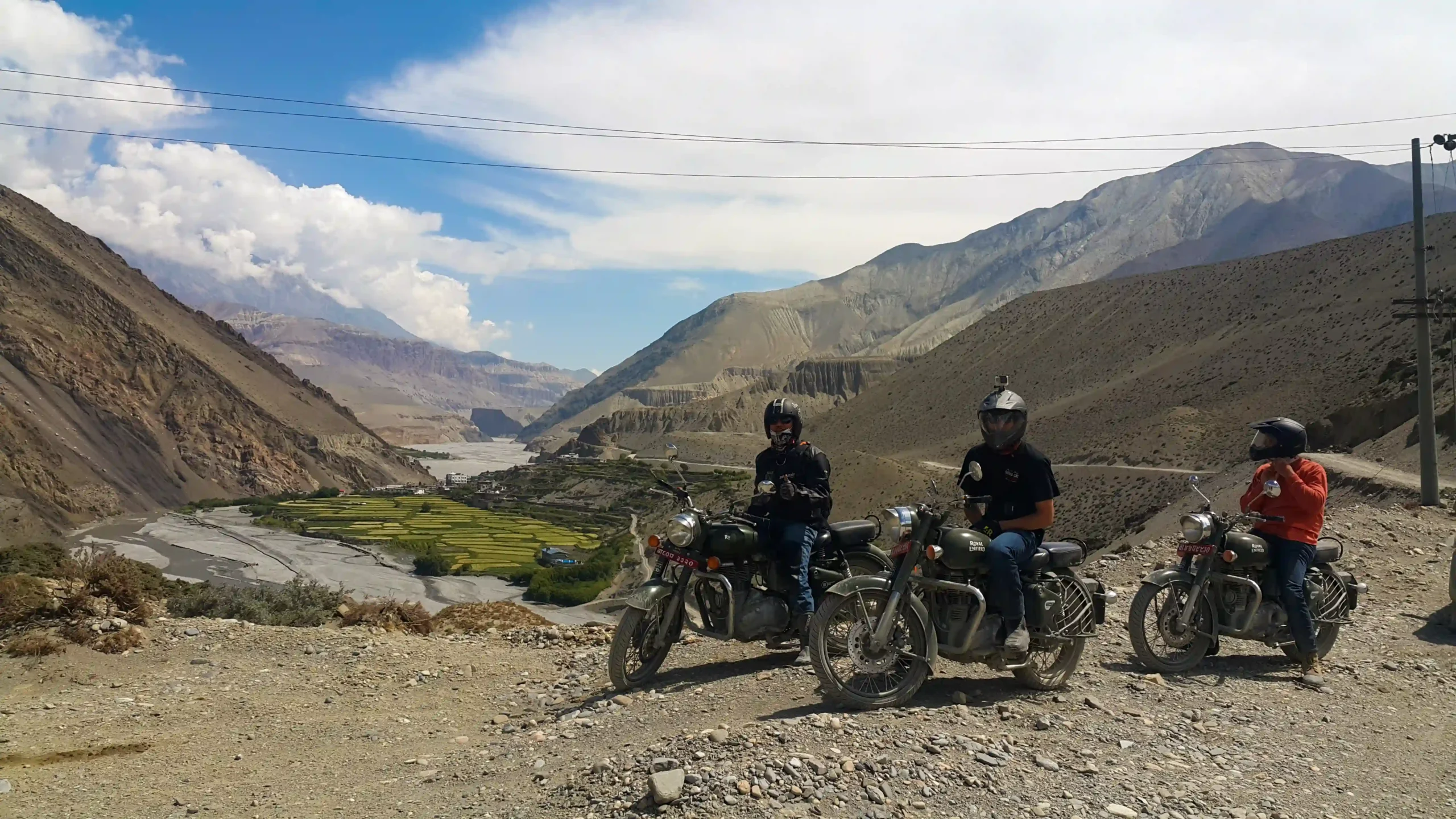
Past Kagbeni, there is only one road, the same road the whole way to Lo Manthang and back. It runs through Chhusang, Chele, Samar, and Syangboche before reaching Ghami, the third-largest village in the Lo region, and on to Charang (also spelled Tsarang), home to an active monastery and a historic dzong. From Charang, the road continues to Lo Manthang itself. This is also where the landscape changes the most; trees mostly disappear except for the ones local families plant around their own homes, and the terrain opens into a dry, high-altitude landscape of eroded earth pillars that looks more like the Tibetan plateau than anywhere else in Nepal.
Lo Manthang and Chhoser Cave
A full day is spent inside the walled city itself, home to three of the most significant monasteries in the region: Jampa Lhakhang, the oldest, built in the early 14th century and known for its mandala paintings; Thubchen Lhakang, a 15th-century assembly hall with ancient wall paintings; and Chode Monastery, the largest of the three, home to a monastic museum. From Lo Manthang, riders head out to Chhoser Cave, the multi-story sky caves carved into the cliffs above the valley, a deliverable, concrete highlight in place of the old itinerary’s border attempt that most riders couldn’t actually complete.
The Road Back
The ride back retraces the same single road through Charang, Ghami, Syangboche, Samar, Chele and Chhusang to Kagbeni, then continues to Jomsom before splitting off toward Tatopani, where natural hot springs make for a welcome stop after several long riding days. From there, the route returns to Pokhara, with a full rest and sightseeing day before the final stretch home through Bandipur, a preserved 18th-century Newari hill town bypassed by the modern highway and left largely untouched.
Firante’s Experience on This Route
Firante runs this route regularly, and every departure travels with a mechanic and a support vehicle carrying spare parts, so breakdowns and fuel logistics are handled without depending on roadside stops in remote sections. Firante’s guides handle the RAP and ACAP permit paperwork and the checkpoint process at Kagbeni directly, so the restricted-area requirements that make this route more complex than an open-road tour are managed for you, not left for you to navigate on arrival.
Upper Mustang Motorbike Tour Highlights
- Ride into Lo Manthang, the walled former capital of the once-independent Kingdom of Lo
- Visit the Chhoser sky caves, including the 2,000+ year-old Shija Jhong Cave and the cliffside Garphu Monastery (Lo Gurfu Gompa)
- See three of Upper Mustang’s most significant monasteries: Jampa Lhakhang, Thubchen Lhakang and Chode Monastery
- Cross Nepal’s longest suspension bridge at Kusma
- Visit Muktinath, with its eternal natural gas flame and 108 pilgrim water taps
- Ride through Marpha, the “Apple Capital of Nepal” and home to the Thakali people
- Soak in the natural hot springs at Tatopani after the return ride
- Explore Bandipur, a preserved 18th-century Newari hill town bypassed by the modern highway
- Watch the landscape change from green valley to high desert firsthand, one of the most dramatic transitions on any ride in Nepal
Upper Mustang Motorbike Tour Itinerary
Expand AllArrival in Kathmandu (1,350 m)
A Firante representative meets you at Tribhuvan International Airport and transfers you to your hotel. In the evening, a briefing covers the route, the bikes, and the permit process, followed by a welcome dinner.
Ride from Kathmandu to Pokhara (820 m)
We leave Kathmandu early in the morning after breakfast, giving us the full day for the ride. The road out runs through the busier Kathmandu–Mugling stretch, shared with heavy freight traffic from the Sunauli and Birgunj border crossings, before opening into a smoother, more scenic road through mountain villages and valley landscapes for the final stretch into Pokhara, roughly 6- 7 hours of riding in total. After checking into a hotel with good facilities and cleaning up, there’s time in the afternoon for a walk along Phewa Lake or an optional bike ride up to Sarangkot, if energy allows after the first long day. Over dinner, we go over any last questions before heading further into the mountains tomorrow.
Ride from Pokhara to Kalopani (2,535m)
The road runs through Beni and Tatopani, an area with some ongoing construction that mainly slows four-wheeled traffic rather than motorbikes. Just past Tatopani, Rupse Chhahara(waterfall) comes into view, a waterfall dropping straight down beside the road, and a natural stopping point to stretch and take photos before continuing on. From there, the route continues to Ghasa (2,010 m), known for its own waterfalls and apple orchards, and Lete (2,480 m), before reaching Kalopani, with views of both Annapurna I and Dhaulagiri on a clear day.
Ride from Kalopani to Muktinath, then Kagbeni
The ride continues through Marpha, the whitewashed Thakali village known for its apple orchards and brandy, and on to Muktinath, one of the most important pilgrimage sites in the Himalaya, home to an eternal natural gas flame and 108 water taps. From Muktinath, the road descends to Kagbeni, the checkpoint village where permits are checked before entering the restricted area.
Ride from Kagbeni to Lo Manthang (3,840m)
Past Kagbeni, there’s a single road the whole way to Lo Manthang, no alternate route, and the riding gets noticeably more technical here: loose gravel through switchbacks, stretches of soft sand where standing on the pegs helps, and the occasional shallow river crossing. It runs through Chhusang and Chele before climbing over Syangboche, one of the higher points on the route, then descends to Ghami (3,520 m), the third-largest village in the Lo region, known for its poplar-lined trail and barley fields. From Ghami, the road continues through Charang (also spelled Tsarang, 3,560 m), home to an active monastery and a historic dzong, before the final stretch into Lo Manthang.
Exploration Day in Lo Manthang, Ride to the Chhoser Caves (~3,900-4,000 m )
A full day inside the walled city. The morning covers Lo Manthang’s three major monasteries: Jampa Lhakhang, the oldest, known for its mandala paintings and thick walls; Thubchen Lhakang, with its large assembly hall and ancient wall paintings; and Chode Monastery, the largest of the three, home to a monastic museum.
In the afternoon, we ride north to Chhoser village (also known locally as Garphu), roughly 9-10 km from Lo Manthang, home to a cluster of genuinely remarkable sites: the Shija Jhong Cave (commonly called Chhoser Cave), a five-story, man-made cave complex believed to be over 2,000 years old, cut into a sandstone cliff with more than 40 interconnected rooms linked by ladders and narrow stone stairways. Nearby is Garphu Monastery (Lo Gurfu Gompa), a small cave monastery built directly into the cliff face, still active, and quieter than the caves themselves. Depending on time and interest, we can also stop at Lo-Nifu Gompa, another cave monastery in the same valley.
Ride from Lo Manthang to Jomsom (2,720m)
The ride back retraces the same single road through Charang, Ghami, Syangboche, Chele and Chhusang to Kagbeni, where permits are checked on the way out, before continuing on to Jomsom.
Ride from Jomsom to Tatopani(1,190 m)
The road retraces the outbound route back through Marpha, the whitewashed Thakali village you rode through on Day 4, this time heading south, and on through Kalopani and Ghasa, dropping steadily out of the high desert and back into greener terrain. By the time you reach Tatopani, the climate change is obvious: warmer air, denser forest, and the sound of the Kali Gandaki running much fuller than it did further north. Tatopani means “hot water” in Nepali, and the natural hot springs here are exactly the reward you’d want after a week of high-altitude riding: a proper soak before the final push back to civilization.
Ride from Tatopani to Pokhara (820 m)
The final riding day of the tour, retracing the Beni corridor south, the same stretch that had some construction-related slowdowns on the way out. Past Beni, the road opens up and runs smoothly the rest of the way into Pokhara. Riders often describe this as the day the trip starts to feel “over”, the mountains behind you, lakeside city ahead, and a proper hotel bed waiting at the end of it.
Sightseeing Day in Pokhara
No riding today (optional short ride to Sarangkot)
A full rest day, and a deliberately built-in one, after nine days on the bike; this is where the schedule finally lets you slow down instead of packing up and moving on. Spend the morning on Phewa Lake, either in a rented rowboat out to the Tal Barahi Temple on its small island, or just having coffee at one of the lakeside cafes. The World Peace Pagoda, a short boat ride and a walk up the hill across the lake, gives a wide view back over Pokhara and the Annapurna range beyond it. For anyone not ready to fully put the bike down yet, an optional short ride up to Sarangkot for sunrise is genuinely worth the early start; on a clear morning it’s one of the best mountain views on the entire trip.
Ride from Pokhara to Bandipur (1,030 m)
A shorter, easier riding day to Bandipur, a preserved 18th-century Newari hill town that the modern highway bypassed entirely in the 1970s, which is exactly why it still looks the way it does. The main bazaar is vehicle-free, red-brick buildings with carved wooden windows and doors line the street, and it feels like a genuinely different Nepal from anywhere else on this route. From the Thani Mai Temple and the open ground of the Tundikhel, the views stretch out to the Annapurna, Dhaulagiri, Manaslu and Langtang ranges all at once. For anyone with energy left, Bandipur is also the gateway to the Siddha Cave, the largest cave in Nepal and the second-largest in Asia, an easy add-on if there’s time before dinner.
Ride from Bandipur to Kathmand (1,350 m)
The final ride back to Kathmandu, rejoining the main highway and retracing the same busier stretch from Day 2 in reverse. In the evening, Firante hosts a farewell dinner to mark the end of the tour, a chance to swap photos and stories from the road with the rest of the group before everyone heads their separate ways the next day.
Final Departure
A Firante representative transfers you to the airport, timed ahead of your flight, bringing the tour to a close.
Airport drop-off by private car
Not quite satisfied with this itinerary?
No worries – every traveler has unique preferences, and we’d be happy to adjust the plan to match your style, comfort, and interests. Let us know what you’d like to add or change, and we’ll create a journey that feels truly yours.
Customize TripCost Includes
- Airport pickup and drop-off by private vehicle
- Hotel accommodation in Kathmandu and Pokhara, with breakfast
- Teahouse/lodge accommodation along the route
- All meals during the tour (breakfast, lunch, dinner)
- Royal Enfield, Hero XPulse 210, or other available bike models
- Fuel for the entire trip
- One road captain/guide and one mechanic, including their accommodation, meals and allowances
- A support vehicle (4WD/jeep) for luggage and backup for the whole trip
- Upper Mustang Restricted Area Permit (USD 50/person/day) and ACAP entry permit
- Minor bike repairs and standard spares (brake shoes, spark plugs, clutch plates, tubes, cables, engine oil), excluding damage from rough handling or accidents
- First aid kit
- All government and local taxes, including VAT
Cost Excludes
- International airfare to and from Nepal
- Nepal entry visa fee
- Personal travel insurance, including medical and evacuation cover
- Motorcycle insurance for accidents or damage
- Personal riding gear and equipment
- Alcoholic and bottled/canned beverages
- Personal expenses (laundry, hot showers, extra snacks, charging fees)
- Tips for guides and support staff
- Extra costs from flight delays, cancellations, illness, or unforeseen circumstances beyond Firante’s control
- Anything not specifically listed under Cost Includes
Additional Informations
Accommodation
Hotels in Kathmandu and Pokhara, and teahouses or local lodges along the route. Facilities become more basic past Kagbeni, standard for the region, though Lo Manthang and the main route towns offer reasonably comfortable options.
Best Season
Firante runs this tour from March to November. Upper Mustang sits in a rain-shadow region, so it stays rideable across a wider window than most high-altitude routes in Nepal, but winter (December–February) brings colder temperatures and less predictable road conditions at altitude, so departures are scheduled outside that window.
Difficulty and Rider Level
This tour suits riders with intermediate experience. The road is paved for much of the approach but turns to gravel, sand, and loose rock past Kagbeni, and long riding days (particularly Days 5 and 7) call for comfort on mixed terrain, not just paved roads.
Permits Required
Two permits cover this route: the Upper Mustang Restricted Area Permit (RAP) and the Annapurna Conservation Area Permit (ACAP). As of late 2025, the RAP changed from a flat USD 500 fee to USD 50 per person, per day, with no minimum stay. This itinerary spends 3 days inside the restricted zone (Kagbeni to Lo Manthang and back to Kagbeni), so the RAP cost works out to roughly USD 150 per person, plus ACAP at NPR 3,000. Both permits are arranged by Firante and included in the package price. (See Firante’s full blog post on the 2026/2027 permit changes for more detail.)
Guide and Support Team
Every departure includes an experienced guide, a mechanic, and a support vehicle carrying spare parts and tools, so fuel and breakdown logistics don’t depend on roadside stops in remote sections of the route.
Bikes & Gear
The tour runs on the Royal Enfield Himalayan 450 and Classic/Bullet 350, the Hero XPulse 210, and other models depending on availability. A short familiarization session on Day 1 lets you get comfortable with your bike before the real riding starts. Personal riding gear, helmet, jacket, gloves, rain gear, and cold-weather layers for the 3,800m+ altitude at Lo Manthang, is the rider’s own responsibility and aren’t provided by Firante.
Getting There and Road Conditions
The road is mostly paved from Kathmandu to Kagbeni, with some construction-related slowdowns around Beni and Tatopani that affect four-wheeled traffic more than motorbikes. Past Kagbeni, the road turns to loose gravel, sand, and small rocks, technical enough to require standing on the pegs through some stretches, though it generally rides smoothly once you’re used to the surface. Mountain views can be fully cloud-covered on some days.
Fuel and Mechanical Support
Petrol stations thin out past Pokhara and disappear entirely inside the restricted zone, so the support vehicle carries extra fuel for the Kagbeni-Lo Manthang-Kagbeni stretch specifically. Every departure also travels with a mechanic and a full set of spares (brake shoes, spark plugs, clutch plates, tubes, cables, engine oil), so a mechanical issue in a remote section doesn’t mean waiting for outside help, the fix comes to you.
Trip Gallery
You may also like

Most companies still fly clients into Simikot. Firante rides there. For decades, reaching Humla meant a small aircraft hop from Nepalgunj, weather permitting, with...
Most riders never think to point their bike west. That’s the whole appeal here. This route runs through country that tourism hasn’t really touched...
The Mt Kailash View Motorbike Tour is not a luxury ride. It’s a real journey into one of Nepal’s most isolated corners, Humla and...
Mustang Valley, located north of the Annapurna Region and situated between Nepal and Tibet, is a remote, mysterious place with winding mountain roads. With...
Magic Nepal Rides
Welcome to luminous, bustling Nepal and to its breathtaking landscapes of mind-boggling naturally picturesque beauty with warm & friendly local communities across the nation....
