
Upper Mustang Motorbike Permits & Costs 2026/2027: What You’ll Actually Pay
 Firante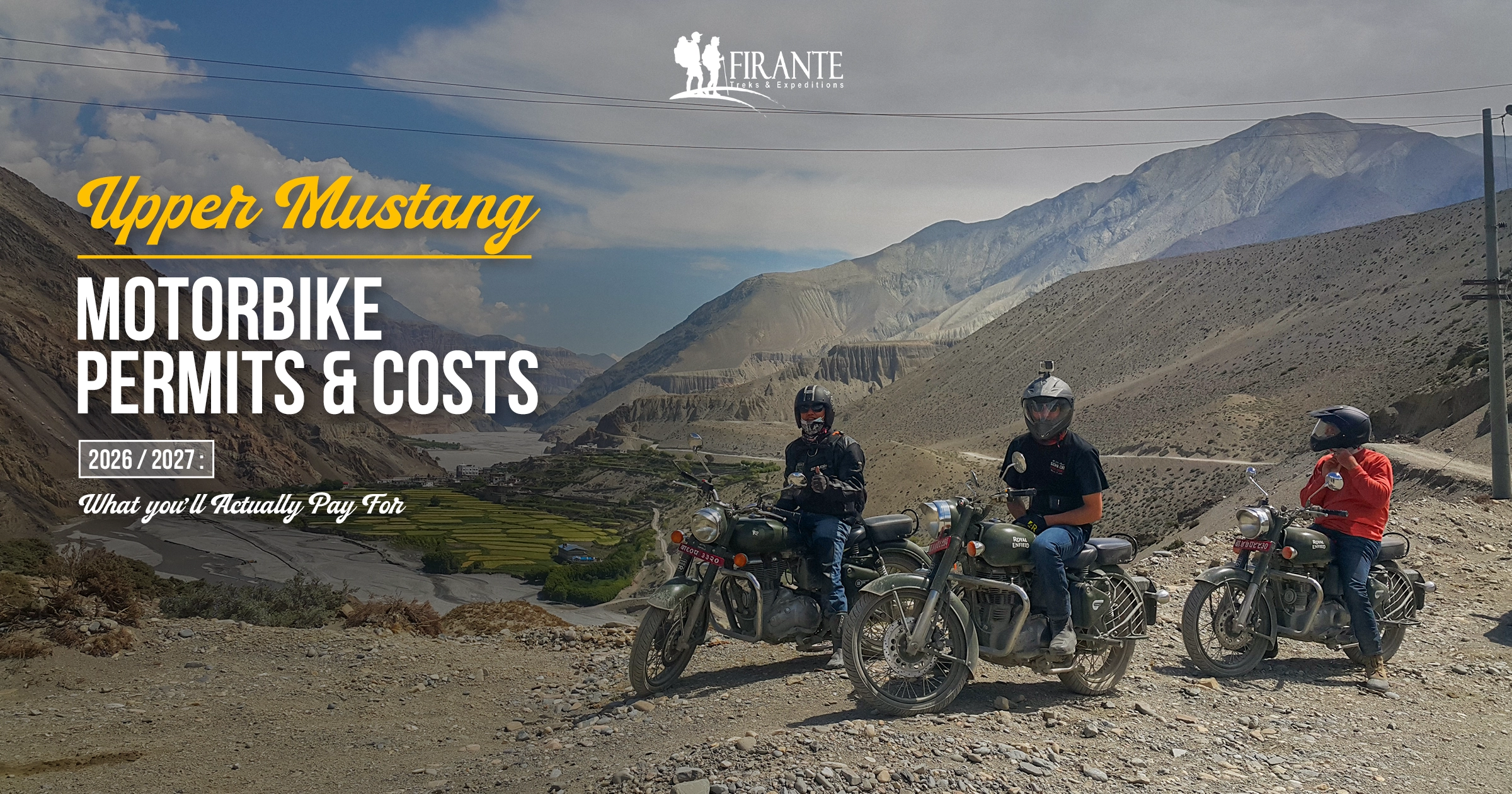
Blog Read Time
Quick Answer
If you’re planning an Upper Mustang motorbike tour in 2026 or 2027, the permit picture changed significantly at the end of 2025. The old flat fee of USD 500 for a mandatory 10-day block is gone. You now pay USD 50 per person, per day, only for the days you’re actually inside the restricted zone. On top of that, you’ll need the standard Annapurna Conservation Area Permit (ACAP) at NPR 3,000 per person. A licensed guide and registered trekking agency are still mandatory, that part hasn’t changed.
If a blog or a quote you’re looking at still mentions $500 as the permit fee, it’s out of date.
Why Upper Mustang Is Worth the Permit Fee
Upper Mustang isn’t restricted by accident. It sits right on the Tibetan border, and until 1992 it was closed to outsiders entirely, a former independent Buddhist kingdom that stayed largely untouched by the modern world. That’s exactly why it still feels the way it does: walled medieval towns, centuries-old monasteries, and a high-desert landscape that looks more like the Tibetan plateau than anywhere else in Nepal. The permit system exists to keep it that way, protecting both the border and the culture, which is part of why the fee, even reduced, still funds something real.
Real places you’ll actually ride through and see, not just pass by:
- Kagbeni — the checkpoint village where the restricted zone officially begins, and where the landscape visibly changes from green to high desert almost immediately.
- Charang — a village en route to Lo Manthang, home to an active monastery, a historic dzong (fort), and some of the best-preserved traditional Mustangi architecture.
- Lo Manthang — the walled former royal capital of the Kingdom of Lo, and the heart of any Upper Mustang trip. Inside its walls are three major monasteries:
- Jampa Lhakhang, the oldest of the three, built in the early 14th century, known for its mandala paintings and unusually thick walls.
- Thubchen Lhakang, a 15th-century monastery with a large assembly hall and ancient wall paintings.
- Chode Monastery (Monchoe Dragkar Thegchen Ling ), the largest and most important of the three, founded in the late 13th century, and home to a monastic museum.
- Ghiling — a quieter, less-visited village that was historically a crossroads of four trade routes between Lo and Tibet, with its own centuries-old monastery, Thrangu Tashi Choling.
- Marpha — known as the “Apple Capital of Nepal,” home to the Thakali people and their distinctive whitewashed stone architecture, a good contrast stop between the green Kali Gandaki valley and the dry landscape further north.
If your dates line up, Lo Manthang also hosts the Tiji Festival, a three-day Tibetan Buddhist celebration usually held in May, drawing in the region’s own communities as much as visitors, one of the few times you’ll see Upper Mustang’s living culture on full display rather than just its architecture.
What Permits Does an Upper Mustang Motorbike Tour Actually Need?
1. Upper Mustang Restricted Area Permit (RAP)
This is the main one, and the one that changed. Upper Mustang has been a restricted area since the 1970s due to its location on the Tibetan border, and this permit is what allows foreign visitors past Kagbeni, the checkpoint where the restricted zone officially begins.
What changed: Nepal’s Cabinet approved the shift from a flat USD 500 (covering a fixed 10-day period, with $50/day charged for any extra days) to a straightforward USD 50 per person, per day, with no minimum. The change was made by amending Schedule 12 of Nepal’s Immigration Regulations, and took full effect by late December 2025.
What this means in practice: a 5-day stay inside the restricted zone now costs USD 250 in permit fees instead of USD 500. A 3-day visit costs USD 150. Shorter, faster-paced trips, which is exactly what a motorbike tour tends to be compared to a slower trek, are now meaningfully cheaper on permits than they were a year ago.
One thing that did NOT change: the restricted-area classification itself, the requirement for a licensed guide, and the requirement to book through a registered agency. This isn’t a fee-only relaxation, Upper Mustang is still one of Nepal’s more tightly regulated regions.
2. Annapurna Conservation Area Permit (ACAP)
Since the route into Upper Mustang runs through the Annapurna Conservation Area before reaching the restricted zone, you’ll also need an ACAP. This one is unchanged: NPR 3,000 per foreign traveler (roughly USD 22-23, depending on the exchange rate).
3. Guide and Agency Requirement
A licensed guide and a registered trekking/travel agency are mandatory for Upper Mustang, motorbike tours included. This applies even under the newer solo-travel rules (below), it just means solo travelers no longer need a second person to share the permit with, not that the guide requirement goes away.
Solo Riders: What Actually Changed
Before 2026, Upper Mustang permits required a minimum of two travelers per group, which was a genuine obstacle for solo riders. As of March 22, 2026, that rule was scrapped. Solo travelers can now get an Upper Mustang permit on their own, provided they still trek or ride with a licensed guide through a registered agency. If you’ve been holding off on an Upper Mustang trip because you couldn’t find a second rider, that barrier is gone.
Example Cost Breakdown
Permit costs scale directly with how many days you spend inside the restricted zone (from Kagbeni onward), not your total trip length. A typical Upper Mustang motorbike tour spends several days on approach roads (Kathmandu, Pokhara, Kalopani) that are outside the restricted area and don’t count toward the RAP.
| Days inside restricted zone | RAP Cost (at $50/day) | ACAP | Approx. Total |
| 3 days | $150 | NPR 3,000 (~$23) | ~$173 |
| 5 days | $250 | NPR 3,000 (~$23) | ~$273 |
| 7 days | $350 | NPR 3,000 (~$23) | ~$373 |
Firante’s Upper Mustang Motorbike Tour, for reference: the route spends 3 days inside the restricted zone (Kagbeni to Lo Manthang, the Lo Manthang exploration and Chhoser Cave day, and Lo Manthang back to Jomsom via Kagbeni), so the permit cost above works out to roughly $173 per person. This is arranged for you and fully included in the package price, so these figures are for comparison if you’re planning independently.
Overstaying Your Permit
There’s no official grace period on the RAP. If you stay in the restricted zone past your permit’s validity, fines are typically in the range of USD 50-100 per day, at the discretion of the enforcing office. This is one more reason to have your guide and agency manage the exact permit dates rather than trying to freelance the timing yourself.
Do You Need to Arrange This Yourself?
No. On a Firante Upper Mustang Motorbike Tour, both the RAP and ACAP are arranged for you and fully included in your package price. You’ll need to provide passport copies and passport photos in advance, and Firante’s team handles the permit paperwork, the checkpoint process at Kagbeni, and the licensed guide requirement as part of the tour.
FAQ (Firante Treks and Expeditions)
How much is the Upper Mustang permit in 2026 or 2027?
The Restricted Area Permit (RAP) is USD 50 per person, per day, with no minimum stay required. You’ll also need the ACAP at NPR 3,000 per person.
Is the old $500 Upper Mustang permit fee still accurate?
No. That flat fee was abolished by a Cabinet decision and fully replaced by the $50/day system by late December 2025. Any source still quoting $500 is outdated.
Can I get an Upper Mustang permit as a solo traveler?
Yes, as of March 22, 2026, the previous two-person minimum was removed. Solo travelers can obtain a permit, but a licensed guide and registered agency are still required.
Does the permit fee apply to motorbike and jeep tours, or just trekking?
It applies to all forms of travel into the restricted area, including motorbike tours, jeep tours, and trekking.
Does Firante arrange these permits for me?
Yes. Both the RAP and ACAP are handled by Firante and included in the price of the Upper Mustang Motorbike Tour package.
How far in advance do I need to apply for the Upper Mustang permit?
Permits are typically processed a few days before the trip starts, since they’re tied to your exact entry dates. On a Firante tour, this is handled for you as part of trip preparation, you don’t need to apply separately or early yourself.
What documents do I need for the Upper Mustang permit?
A copy of your passport and passport-sized photos. Firante collects these from you in advance and handles the permit paperwork and the checkpoint process at Kagbeni.
What happens if I overstay my Upper Mustang permit?
There’s no official grace period. Overstaying typically results in a fine of USD 50-100 per day, at the discretion of the enforcing office. Your guide manages the exact permit dates as part of the tour, so this isn’t something travelers need to track themselves.