
Mt. Kailash Motorbike Tour from Nepal: Complete Visa and Permit Guide 2026
 Firante
Blog Read Time
Planning a Mt. Kailash motorbike tour from Nepal is one of the most rewarding decisions a serious adventure rider can make, and far simpler than most people expect. Unlike the Tibet-side route, the Nepal approach through Humla’s Limi Valley requires no Chinese group visa, no Tibet Travel Permit, and no locked-down itinerary. You ride entirely within Nepal while reaching Lapcha Syar Viewpoint (5,133 m), one of the closest accessible points to Mt. Kailash (6,638 m) and Lake Manasarovar without crossing the border.
At Firante Treks and Expeditions, our Humla-based team members were born and raised in these valleys. This guide reflects current, verified permit fees, real riding experience, and on-the-ground knowledge from people who actually live and work here.
To do this tour, you need: (1) a Nepal Tourist Visa, available on arrival for most nationalities, and (2) a Humla Restricted Area Permit at USD 50 for 7 days. No Tibet visa. No Chinese permit. That is it.
What This Guide Covers
- Why the Nepal-side route is now possible and why it is the smarter choice
- Nepal visa requirements for international riders, with 2026 verified fees
- Humla Restricted Area Permit: exact costs, how to apply, and processing time
- Permits you do not need, and why that matters
- Day-by-day itinerary from Kathmandu to Lapcha Syar Viewpoint
- Best time to go, bike setup, health tips, and packing list
- Cost breakdown and answers to the most common questions
A Historic Route: How Humla Finally Connected to Nepal’s Road Network
For most of Nepal’s history, Humla was one of the most isolated districts in the country. The Karnali region had no road connection to the national highway network, meaning access to Simikot required either a domestic flight or a multi-day walk from the nearest roadhead. This made any motorbike tour to Humla impossible.
That changed with a landmark infrastructure project completed in 2025. Here is the accurate timeline:
- Construction of the Karnali Corridor road linking Humla to Nepal’s national network began around 1999.
- The Nepal Army took over major construction work in 2015, accelerating progress through extremely difficult terrain.
- The road track through to the lower Humla sections was largely completed through 2023 and 2024, allowing limited vehicle access in parts of lower Humla.
- July 6, 2025: Prime Minister KP Sharma Oli inaugurated a Bailey bridge over the Chuwakhola River, completing the final link in the Karnali Corridor. Simikot, the district headquarters of Humla, became officially connected to Nepal’s national road network.
- This made Humla the last of Nepal’s 77 districts to be connected to the national road system, completing a 26-year infrastructure effort.
The practical result for adventure riders is significant. This motorbike tour is only possible because of the 2025 road completion. Before this, trekking and fly-in expeditions were the only ways to reach Simikot and the Limi Valley. If you have seen older blogs or itineraries describing a Humla motorbike tour from before 2025, treat that information with caution. This is a genuinely new route.
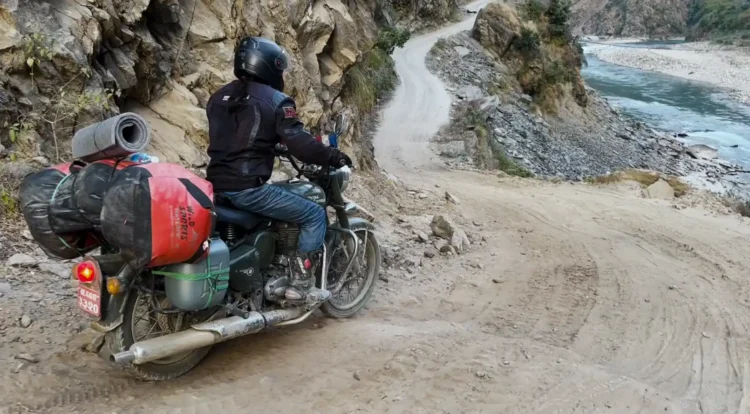
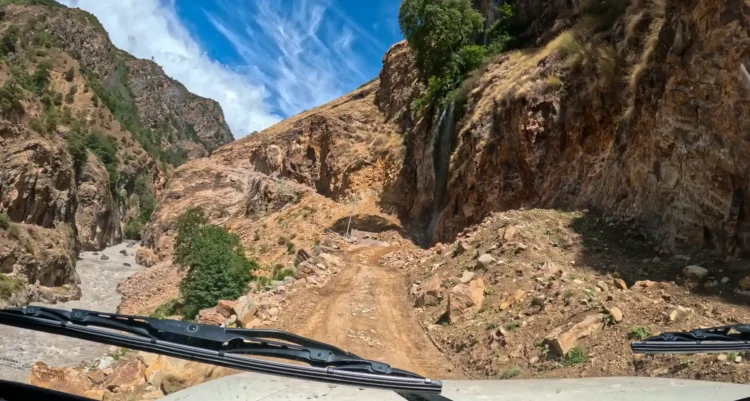
Because the road is newly completed, conditions on some sections remain rough and are evolving. Our team monitors the route condition after every departure and updates logistics accordingly. This is one of the reasons having a local operator who actually rides this road regularly is not optional.
Why the Nepal-Side Route Is the Smarter Choice
The classic Tibet-side Kailash circuit requires a Chinese Group Tourist Visa, Tibet Travel Permit (TTP), Aliens Travel Permit, and often a Military Area Permit. These take weeks to arrange, cost hundreds of dollars in agency fees alone, and restrict you to pre-approved groups and fixed itineraries.
The Nepal-side route through Humla eliminates every one of those barriers:
- No Chinese or Tibetan permits of any kind
- Flexible, small-group riding at your own pace
- Deep cultural immersion through Karnali villages, ancient Bon monasteries, and natural hot springs
- Lapcha Syar Viewpoint delivers a clear, close view of Mt. Kailash and Lake Manasarovar on most clear mornings
- Genuine off-road Himalayan riding through one of Nepal’s most recently opened districts
Nepal Tourist Visa Requirements for International Riders (2026)
Most international riders can obtain a Nepal Tourist Visa on arrival at Tribhuvan International Airport (Kathmandu) or at major land border crossings. The process typically takes 20 to 40 minutes.
Visa Fees at a Glance
| Visa Type | Duration | Fee (USD) | Best For |
| Tourist Visa on Arrival | 15 days | USD 30 | Short trips |
| Tourist Visa on Arrival | 30 days | USD 50 | Standard tour |
| Tourist Visa on Arrival | 90 days | USD 125 | Extended stay |
| Indian Nationals | Unlimited | Free | Passport or Voter ID |
Documents Required at Arrival
- Passport valid for at least 6 months beyond your planned departure, with at least one blank page
- One recent passport-sized photo (digital booths are available at Kathmandu airport if needed)
- Completed visa application form. Filling this online at nepalimmigration.gov.np before you fly saves time at the counter.
- Payment in USD, EUR, or GBP. Exact change is preferred.
- Proof of onward or return travel, which is sometimes requested
Who Must Apply in Advance
Citizens of the following countries cannot obtain a visa on arrival. They must apply through a Nepali embassy before travelling: Nigeria, Ghana, Zimbabwe, Cameroon, Somalia, Liberia, Ethiopia, Iraq, Palestine, Afghanistan, Syria, Iran, and holders of refugee travel documents. If you hold one of these passports, contact your nearest Nepali embassy at least 4 weeks before your intended departure.
Arrive in Kathmandu 2 to 3 days before the tour starts. This allows time for jet lag recovery, permit processing, a bike fitting session, and an optional visit to Boudhanath Stupa or Pashupatinath. Permits cannot be processed in fewer than 7 working days.
Humla Restricted Area Permit: The Key Permit You Need
Humla is a restricted border district in far-western Nepal, sharing a long frontier with Tibet. The Humla Restricted Area Permit (RAP) is mandatory for all foreign nationals entering the district. It is issued by Nepal’s Department of Immigration and can only be processed through a registered trekking or tour operator. Individual applications are not accepted.
2026 Humla RAP Fee Structure (Verified with Department of Immigration)
| Permit / Fee | Cost 2026 |
| Humla Restricted Area Permit, first 7 days | USD 50 per person |
| Humla RAP, each additional day beyond 7 | USD 10 per person per day |
| Namkha Rural Municipality / Conservation Entry | NPR 3,000 to 5,000 per person |
| TIMS Card (where applicable) | As applicable |
| District Development Committee tax | As applicable |
The USD 50 for 7 days and USD 10 per additional day reflects the current fee as listed by Nepal’s Department of Immigration, verified June 2026. Fees can change at the start of Nepal’s fiscal year in mid-July. We update this guide when changes occur.
How Firante Handles Your Permits
Once you confirm your booking, our Kathmandu office begins permit processing immediately. Here is what we handle on your behalf:
- Submit your passport copy, photo, and application to the Department of Immigration
- Pay permit fees and collect the official permit document
- Register your International Driving Permit and motorcycle for the route
- Obtain all required local municipality and conservation area entry clearances
- Arrange your TIMS card if applicable to your itinerary
Processing time: 7 to 14 working days from the date we receive your documents. We strongly recommend booking at least 3 to 4 weeks before your intended departure date.
Motorcycle Requirements for the Humla Route
- Motorcycle must be legally registered in Nepal or customs-cleared for the route. Firante handles this process.
- An International Driving Permit (IDP) is required alongside your national driving licence
- Minimum group size is 2 riders. Solo riders are welcome on our scheduled group departures.
- Recommended bike: Royal Enfield Himalayan 450cc or an equivalent adventure touring motorcycle
Permits You Do NOT Need for This Tour
Because the entire route stays within Nepal’s borders, the following permits are completely unnecessary:
- Chinese Group Tourist Visa: not required
- Tibet Travel Permit (TTP): not required
- Aliens Travel Permit (ATP): not required
- Military Area Permit: not required
- Frontier Pass: not required
Compared to traditional Tibet-side Kailash tours, this saves roughly 4 to 6 weeks of advance permit processing and USD 500 to 800 in permit fees alone.
Day-by-Day Itinerary: 9 to 12 Days, Kathmandu to Lapcha Syar Viewpoint
Our standard package runs 9 days, with optional extensions to 12 days for riders who want extra acclimatisation time or a deeper exploration of the Limi Valley. All distances, stop names, road descriptions, and meal notes below come from actual guided departures.
Day 1: Kathmandu to Butwal (approximately 280 km, 7 to 8 hours)
We start from Firante’s Kathmandu base early in the morning to avoid city traffic. The route follows the Prithvi Highway towards Mugling, then south along the Narayangadh highway. Lunch stop at Kurintar, where the riverside dal bhat is genuinely worth the stop. We continue through Narayanghat and reach Butwal by late evening. Overnight in Butwal.
Road condition: Sealed highway. Good warm-up day with moderate traffic.
Day 2: Butwal to Surkhet (approximately 220 km, 6 to 7 hours)
Flat Terai highway riding across the Inner Terai plains. Fast, open road. We cross Dang Valley, pass through the checkpoint at Kohalpur, and enter Karnali Province. Surkhet is the last major town before the terrain changes. Stock up on supplies here.
Road condition: Sealed highway. The smoothest riding of the entire journey.
Day 3: Surkhet to Pilichaur (approximately 180 km, 7 to 9 hours)
The character of the trip shifts here. We take the Gurase Danda road, a scenic ridge route with sweeping mountain views that most tourists never see. Lunch at Tallo Dungeshwor, where the Karnali fish curry is one of the best meals of the entire trip. The afternoon brings rougher gravel through Rakam Karnali, Kalikot district, and Sannighat before arriving at the quiet riverside settlement of Pilichaur on the Karnali River.
Road condition: Mix of rough tarmac and packed gravel. First technical riding of the tour.
Day 4: Pilichaur to Simikot (approximately 150 km, 7 to 9 hours)
True off-road riding begins. We enter the Bajura district and push into Humla on gravel and rocky tracks. Lunch in Sallisalla. The final stretch via Sarkegad climbs steadily to Simikot, the administrative headquarters of Humla at 2,910 m, a beautiful mountain town framed by snow-capped peaks. Permits are checked at the official checkpoint here.
This section uses the newly completed Karnali Corridor road, inaugurated in July 2025. Some stretches remain rough and are actively being improved. Conditions after heavy rain can make certain sections more challenging.
Road condition: Gravel and rough tracks. Expect river crossings in monsoon-adjacent seasons. Challenging and very rewarding.
Day 5: Simikot to Dukling via Nyalu La Pass (approximately 80 km, 6 to 8 hours)
The highest riding day of the tour. We climb from Simikot through the Chyachada Waterfall gorge and up through Kermi Village. Nyalu La Pass at 5,080 m is the physical and emotional high point. On clear days, distant Himalayan peaks appear in every direction. The descent passes Seliman Lake and Talung Lake before reaching the tiny settlement of Dukling for the night.
Road condition: Narrow mountain track with loose rock above 4,500 m. Cold even in May. Ride slowly.
Day 6: Lapcha Syar Viewpoint, Mt. Kailash and Lake Manasarovar Panorama
The reason for the entire journey. We depart before dawn for the Lapcha Syar Viewpoint at 5,133 m. As the sun rises over the Tibetan plateau, Mt. Kailash (6,638 m) appears to the northwest, its distinctive four-faced pyramid summit clearly identifiable. On clear mornings, Lake Manasarovar is visible as a deep blue expanse on the plateau below. We typically spend 1 to 2 hours at the viewpoint. On the return ride, wild yaks and Tibetan wild asses (kiang) are frequently spotted on the plateau grasslands.
Best viewing window: April to May and September to October. Morning light before 10:00 AM gives the clearest conditions.
Day 7: Halji Monastery and Limi Valley Rest Day
A rest and cultural immersion day. We visit Halji Rinchenling Monastery, one of the oldest active Bon monasteries in Nepal, dating to the 11th century. The afternoon offers time in the natural hot springs near the village. The silence and the quality of light in Limi Valley in the afternoon, with yaks grazing above and prayer flags in the wind, is something riders consistently describe as one of the most memorable parts of the trip.
Day 8: Return Ride to Simikot
We retrace the trail south through Dukling, back over Nyalu La, and down to Simikot. The return is faster but no less dramatic. You see the route differently riding south. Evening farewell gathering with the local crew in Simikot.
Day 9: Simikot to Nepalgunj to Kathmandu by Flight
Morning flight from Simikot to Nepalgunj on a small mountain aircraft, approximately 45 minutes. Connect to Kathmandu from Nepalgunj. Farewell dinner that evening to share photos and stories from the road.
Our 11 to 12-day packages include 2 to 3 buffer days for weather delays, deeper Limi Valley exploration, or an optional side ride to Rara Lake, the largest lake in Nepal, located about 2 days from Surkhet.
Best Time for the Mt. Kailash Motorbike Tour from Nepal
- Spring, April to May: Stable weather, wildflowers on the lower passes, good visibility. April is drier. May has occasional afternoon clouds.
- Autumn, September to October: Post-monsoon clarity gives the sharpest Kailash views. October is our personal recommendation for first-time riders.
- Winter, November to March: Nyalu La Pass may be blocked by snow. Only suitable for experienced cold-weather riders with full winter gear.
- Monsoon, June to August: Lower valley roads become very muddy, and river crossings can be risky. The high passes often remain accessible but logistics are harder. Not recommended for first-timers.
Preparation: Bikes, Health, and What to Pack
Motorcycle Setup
Firante provides fully serviced rental bikes (Royal Enfield Himalayan 450cc) with support vehicles, spare parts, a dedicated mechanic, and fuel logistics. If you are bringing your own motorcycle, it must be legally cleared for Nepal roads, and we recommend a full service before leaving Kathmandu. Tubeless tyres are strongly preferred because punctures are common on this route.
Health and Altitude
- Nyalu La Pass (5,080 m) and Lapcha Syar Viewpoint (5,133 m) are genuine high-altitude environments
- Consult a doctor about Diamox (acetazolamide) for AMS prevention. Starting one day before reaching 3,500 m is the standard approach.
- Our itinerary builds in a gentle altitude gain on Days 4 and 5 before the high passes
- Travel insurance must specifically cover high-altitude motorbike riding and helicopter evacuation. Verify this with your insurer before you book.
What to Pack (Specific to This Route)
- Layered riding gear: base layer, fleece, and waterproof outer shell. The temperature at Nyalu La in April can reach minus 5 degrees Celsius even at midday.
- Full safety kit: full-face helmet, riding jacket with CE2 armour, protective gloves, ankle-supporting boots
- 20,000 mAh power bank. There is no mains electricity between Sarkegad and Dukling.
- Waterproof dry bags or panniers. River crossings and rain are virtually guaranteed on most departures.
- Binoculars, 8×42 or similar. Essential for watching Kailash at Lapcha Syar and spotting wildlife on the plateau.
- Personal medications, blister treatment, and basic first aid. Our support vehicle carries a comprehensive kit.
- USD cash in small denominations. Local teahouses in Humla do not accept cards.
Estimated Cost Breakdown (2026)
Our packages start from USD 2,800 per person for groups of 4 or more, up to approximately USD 3,800 for private departures. See our Mt. Kailash View Motorbike Tour package page for current pricing and available departure dates.
The package includes:
- All permits and paperwork: Humla RAP, local fees, TIMS, and IDP processing
- Bike rental (Royal Enfield Himalayan 450cc) or bike support for your own motorcycle
- All accommodation in tea houses and guesthouses along the route
- All meals during the tour
- Professional guide, assistant guide, mechanic, and local Humla crew
- Domestic flights: Simikot to Nepalgunj to Kathmandu
- 4WD backup support vehicle with spare parts and fuel logistics
International flights, Nepal visa fee, and personal travel insurance are not included. Contact us for a personalised quote based on your group size, preferred dates, and whether you are bringing your own motorcycle.
Frequently Asked Questions
Do I need a Tibet visa or a Tibet Travel Permit for this tour?
No. This tour stays entirely within Nepal’s borders. You need only a Nepal Tourist Visa and the Humla Restricted Area Permit. No Chinese visa, no Tibet Travel Permit, no Aliens Travel Permit, and no Military Area Permit are required at any stage.
How much does the Humla Restricted Area Permit cost in 2026?
The Humla RAP costs USD 50 per person for the first 7 days, with USD 10 per person for each additional day. This is the current fee verified with Nepal’s Department of Immigration. Additional local municipality and conservation fees of approximately NPR 3,000 to 5,000 per person also apply.
When did the road to Humla and Simikot open?
Simikot was officially connected to Nepal’s national road network on July 6, 2025, when Prime Minister KP Sharma Oli inaugurated a Bailey bridge over the Chuwakhola River, completing the final link in the Karnali Corridor. Humla was the last of Nepal’s 77 districts to receive a road connection. Construction of the Karnali Corridor had started around 1999 and took 26 years to complete.
Can I actually see Mt. Kailash clearly from Nepal?
Yes, and on clear days, the view from Lapcha Syar Viewpoint (5,133 m) is exceptional. Mt. Kailash is approximately 35 km from the viewpoint and its distinctive pyramid summit is clearly visible with the naked eye. Lake Manasarovar is also visible on the Tibetan plateau. Morning light before 10:00 AM provides the best conditions. April to May and September to October offer the highest success rate for clear views.
Is this tour suitable for beginner riders?
The route includes significant off-road sections, including gravel, loose rock, river crossings, and high-altitude riding above 5,000 m. We classify it as intermediate to advanced. Riders should have at least some prior off-road or mountain riding experience. If you are a passionate beginner, contact us, and we can discuss preparation options before the main tour.
Can solo riders join this tour?
Yes. The minimum group size for a private departure is 2 riders. Solo riders are welcome on our scheduled group departures, which typically run in April, May, September, and October. Contact us for the current departure calendar.
How long does it take to get the Humla permit?
We require 7 to 14 working days from the date we receive your passport copy and documents. This is the standard processing time at the Department of Immigration. We handle the entire process on your behalf. You do not need to visit any government office.
What happens if the weather blocks the viewpoint on our planned day?
Our 11 to 12-day packages include 2 to 3 buffer days specifically for weather. If conditions prevent the Lapcha Syar visit on the planned day, we will wait for the next clear window. In rare cases of extended bad weather, we adjust the itinerary based on our local team’s knowledge of conditions in that season.
Are there cultural protocols I should be aware of?
Limi Valley communities follow Tibetan Buddhist traditions. Walk clockwise around monasteries and prayer wheels. Remove shoes before entering monastery interiors. Ask before photographing residents, especially elders and monks. Avoid pointing with your index finger and use your whole hand instead. Our guides provide a full cultural briefing before entering the Humla district.
Final Thoughts: More Than a Motorbike Tour
The Nepal-side Kailash motorbike journey is one of the most complete adventure experiences available in the Himalayas. It combines technically demanding off-road riding, genuinely remote landscapes, 11th-century monasteries, and a dawn view of one of the most sacred mountains on earth, all without a single Chinese government permit.
This is a genuinely new route made possible by the completion of the Karnali Corridor in 2025. Our team knows every section of this road, every checkpoint, every teahouse, and every local family along the way. That knowledge comes from actually being here.
Ready to plan your tour? Visit our Mt. Kailash View Motorbike Tour package page and send us a message. We respond within 24 hours.
Namaste and safe riding. Firante Treks & Expeditions, Kathmandu and Simikot, Nepal