
Riding the Upper Mustang Motorbike Tour: What the Road Actually Feels Like
 Firante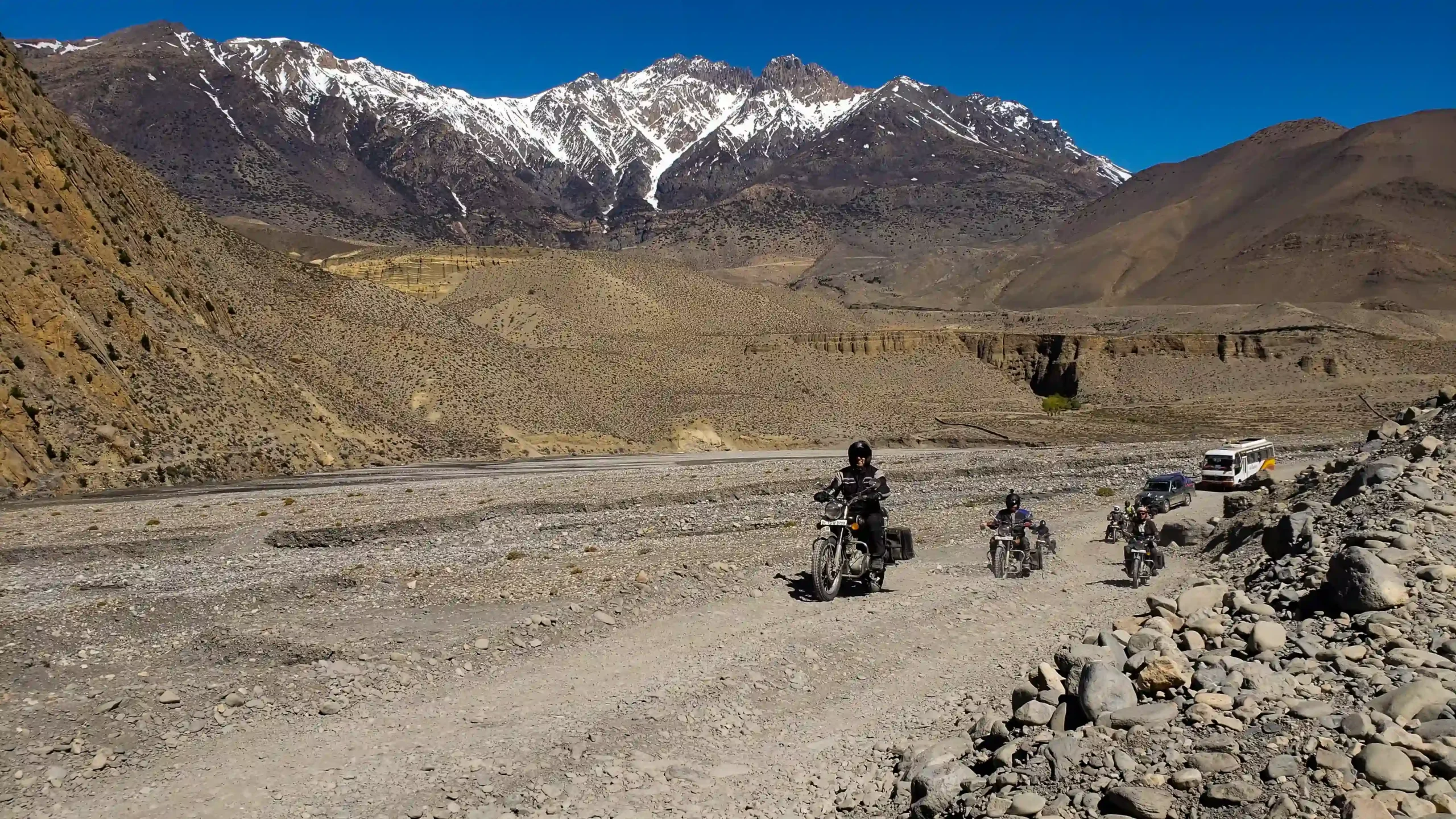
Blog Read Time
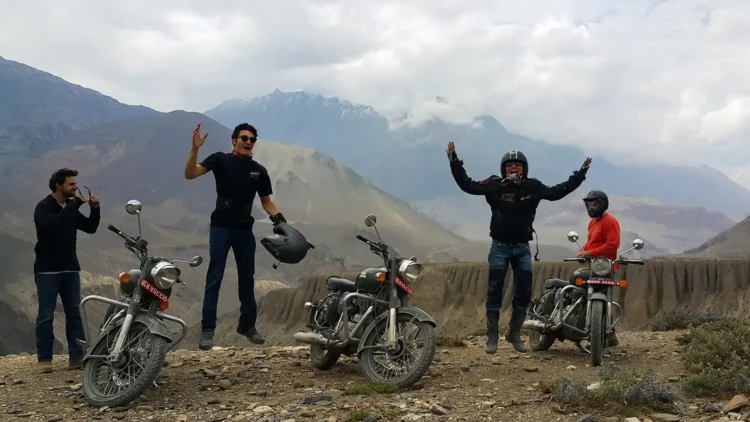
The last wild tree disappears somewhere past Kagbeni. What green you still see after that is deliberate, small clusters planted by local families around their own homes, not the landscape itself. Everything past those pockets is a red cliff and open desert. Nobody warns you it happens that fast. That’s the Upper Mustang, and it’s the moment this whole ride is really about.
We’ve ridden this route in June, July, and November, three very different versions of the same road, and by the end of this post you’ll know which one actually fits what you’re looking for.
Getting Out of Kathmandu on the Upper Mustang Motorbike Tour
Kathmandu to Pokhara covers about 200 kilometers, and the first stretch to Mugling is the one part of the whole trip that feels more like traffic management than riding. Heavy container trucks loaded up from the Sunauli and Birgunj borders share the road with long-distance buses, and the pace stays slow and chaotic until Mugling. Past that, it’s a different road entirely, a smooth two-hour ride into Pokhara, enough of a reset before an evening on the lake during the Upper Mustang Motorbike Tour.
From Pokhara, the road earns its reputation fast. It crosses Kusma’s suspension bridge, the longest in Nepal, then hits Beni, where the pavement gives out, and the trip stops being a scenic ride and starts being an Upper Mustang Motorbike Tour. The climb through Ghasa and Lete brings you into Kalopani, one of the only points on the entire route where Annapurna I and Dhaulagiri stand visible on opposite sides of the valley at the same time. Worth stopping for, even if you’re behind schedule.
Jomsom comes next, and just past it, a small lake most riders never even know is there. Dhumba Lake sits just off the main road, quiet and easy to reach, the kind of stop that doesn’t make it into most itineraries but should. From Jomsom, the road continues to Muktinath, at 3,800 meters, one of the few places in the world held sacred by both Hindus and Buddhists at once. Hindus know it as one of the holiest Vishnu temples in the subcontinent, while Buddhists consider it a place of dakinis, sky dancers, and count it among their own pilgrimage sites. The 108 water spouts ring the temple courtyard, and pilgrims move through them one by one regardless of how cold the water runs. Just behind the main temple, a small flame burns continuously off natural gas seeping through the rock, a detail that’s kept the site significant for centuries, fire and water existing side by side in a way that shows up in the mythology of both religions. From there, the road drops to Kagbeni, the gateway to the Upper Mustang Motorbike Tour.
Where the Real Ride Begins
Kagbeni isn’t just another village. It’s the checkpoint, the last stamp before Upper Mustang motorbike tour proper, and the same check happens again on the way out days later. Cross it, and the landscape changes almost before you’ve noticed the village behind you. The wild trees thin out to nothing, leaving only the small planted clusters around scattered homes, everything else stripped down to open desert.
What fills the emptiness instead are earth pyramids, spires of eroded rock and pale clay standing straight up out of the valley floor, shaped by wind and water over what must be thousands of years. There’s no good way to describe riding past them for the first time except to say it’s the moment most people remember longest after the trip ends.
The road keeps climbing through Ghami, then Charang, past Tibetan-style homes with wide balconies. Poplar trees, planted in rows near the villages the same way locals plant them around their own homes, break up the otherwise bare hillsides, alongside barley fields cutting green lines through the dry land.
Locally, the poplar is known as “Bhote Pipal.” Before Lo Manthang, one last climb brings you to a viewpoint with a full 360-degree view over the valley, arguably the single best place on the whole route to just stop and look.
Inside the Walls of Lo Manthang
Lo Manthang was the capital of an independent kingdom, and it still carries itself that way. Three monasteries sit inside the walls. Jampa Lhakhang is the oldest, from the early 14th century, its interior covered in mandala paintings that have somehow held their color for seven hundred years. Thubchen Lhakang came a century later, its assembly hall large enough to swallow sound. Chode Monastery is the biggest of the three, still the principal Sakya monastery in the region, and now doubles as a small museum. A rest day here goes fast. Between the three monasteries, the old Royal Palace, and just walking the walled city itself, there isn’t much daylight left over.
Time it right and you might catch the Tiji Festival, a three-day Tibetan Buddhist celebrations are held here every year, usually in May or early June. It reenacts the myth of the deity Dorje Jono defeating a demon, the triumph of good over evil, and it’s one of the few times Lo Manthang gets genuinely lively, with masked dances filling the courtyard in front of the palace. In 2026 it falls on May 14-16, worth building a trip around if the timing lines up.
From Lo Manthang, the road pushes further, out toward Korala, the checkpoint nearest China. You can’t cross here, foreigners aren’t permitted past it, but the ride out is worth doing anyway. This stretch carried salt caravans between Nepal and Tibet for centuries before it carried tourists, and the Jhong Caves along the way, cliffside dwellings carved across multiple stories, are still something researchers argue about the purpose of.
The Long Way Back
The return route is faster but no less interesting. Ghiling, quieter than Ghami or Tsarang, is built around a monastery that literally splits the village in half, homes on one side, the school on the other. From there it’s mostly downhill back to Kagbeni, Annapurna and Nilgiri reappearing on the ride down.
Past Kagbeni again, Marpha is worth pulling over for. It’s Nepal’s Apple Capital, home to the Thakali people, whitewashed stone houses lining narrow streets, and it’s where Marpha brandy comes from, a fruit spirit distilled from local apples, apricots, and pears that makes for one of the better things you’ll carry home. The road here turns to gravel and packed sand, easy riding with Nilgiri, Tilicho Peak, and the Annapurna range in view whenever the clouds cooperate.
Tatopani’s hot springs feel earned by the time you reach them, several long days into the saddle. Past that, the road through Beni is under construction in places, though it slows down cars far more than bikes. The last real stop is Bandipur, a Newari town the highway bypassed back in the 1970s, which is exactly why the old red-brick houses and carved wooden windows are all still standing. From the Thani Mai Temple, the last real mountain view of the trip stretches across four ranges at once before the road drops back into Kathmandu’s traffic.
What You Need to Know Before You Go
This is not a do-it-yourself rental approach and ride. Joining a group means a vehicle will support you during the entire trip, which makes the remote parts of Upper Mustang much more accessible. Nevertheless, the participants still need to have some riding skills because those gravel roads, sandy routes, and high altitudes can make it really difficult to ride as a beginner
Two permits are required: the Annapurna Conservation Area Permit, a flat Rs 3,000, and the Upper Mustang Restricted Area Permit, which costs $50 USD per day from day one. This is a recent change. Until late 2025, the permit came with a mandatory $500 flat fee covering the first 10 days regardless of trip length. That rule was abolished by a Cabinet decision on November 19, 2025, fully in effect by December 22, 2025, so trips now cost only for the days actually spent inside the restricted area. Both permits get checked at Kagbeni before you’re allowed further. Accommodation is better than most people expect out here too, proper hotels with real facilities are available all the way up to Lo Manthang, not just basic teahouses
When to Actually Go
There’s no wrong season here, but there is a different ride depending on when you show up. June means quieter roads and a greener valley, helped along by pipal trees local communities have been planting in recent years. October and November flip that entirely, drier trails, clearer views of snow on the surrounding peaks, and noticeably more traffic, since this overlaps with the busiest trekking season in the region. Either way, this is a route that doesn’t feel like anywhere else in Nepal. That’s the whole reason to ride it.
Final Thought
The Upper Mustang Motorbike Tour doesn’t just provide a motorcycle tour through the mountains of Nepal. It provides a passage across forgotten trading routes, into dry, desert lands situated high in the altitude, through old monasteries of centuries past, and through some otherworldly-feeling scenery to that of the otherwise Himalayan terrain. Right from the busy highways of Kathmandu to the closed kingdom of Lo Manthang, one feels a unique experience for every day spent on the ride.
More than the actual destination, one finds it all the more fascinating to do the Upper Mustang Motorbike Tour as the scenery keeps changing and so does the culture that goes around with this road of adventure. Indeed, you can either do this ride through the relatively green month of June, or in the pure, crisp air of autumn. You will find that it doesn’t get any different when it comes to experiencing Nepal like never before.
At firante.com, we believe in sharing and exploring the globe through travels that comprise both – genuine experiences and remarkable vistas. Our guided Upper Mustang Motorbike Tour ensures riders navigate the off-limits regions of this unique, isolated Himalayan land safely, sound, and secure.
For those seeking an adventure out-of-the-ordinary – one that’s a little different from common trekking escapades – your go-to motorbike adventure is undoubtedly the Upper Mustang Motorbike Tour. Step beyond familiar landscapes, witness age-old cultures, and experience the deserted beauty of the forbidden kingdom of Lo Manthang with Firante Treks to have an out-of-the-ordinary motorbike touring experience in the Himalayas.